Review: Iron Man #78

Iron Man, Meet Bill Mantlo!
Iron Man #78, you’re killing me!
My schtick is writing reviews that are meant to be an engaging mashup of fun along with some background info. It’s all tongue-in-cheek when I dish out some less than sterling comments on the stories and art. And the three people who follow this post - two of whom owe me money! - seemed to enjoy all of it.
But then you come along. An entire issue devoted to the flipping Viet Nam War. Years of nightmarish conflicts that had torn our country apart for over a decade and that we were slowly realizing had been one terrible mistake.
How can I offer any silly commentary on that? Only the crassest, most insensitive individuals would tread on such unwanted ground.

I will offer my thoughts on this review. Out of respect for its content, I’ll behave myself. But don’t worry, without giving anything away, I guarantee that the next issue will allow me to more than make up for it!
As for my reaction to Iron Man #78 as a kid, I had a hard time with it. Although too young to have had to worry about the draft, I appreciated the message that guest writer Bill Mantlo sought to communicate. But dammit, this was another delay in that blasted Black Lama story! And just two months after a stinking reprint in #76. It’s not that I loved that storyline. But it had dragged on long enough as it was. I was seeking at least a glimmer of light in a long, winding tunnel.
Absent that, I had no choice but to check out, “Long Time Gone.”

Credits
Writer: Bill Mantlo
Penciller: George Tuska
Inker: Vince Colletta
Colorist: Phil Rachelson
Letterer: John Costanza
Editor: Len Wein
Cover Art: Gil Kane & Vince Colletta
Release Date: June 24, 1975
Synopsis
We’re still mired in a period of mediocre Gil Kane covers with this one definitely falling onto the weaker end of that spectrum. However, the splash page returns both George Tuska and Vince Coletta to the art. A definitely welcome change after four issues of a struggling young Arvell Jones.
Tony Stark is reflecting on a memory with an image of the “pointy face mask” armor behind him. A funky old suit that gives us a break from that damned nose!
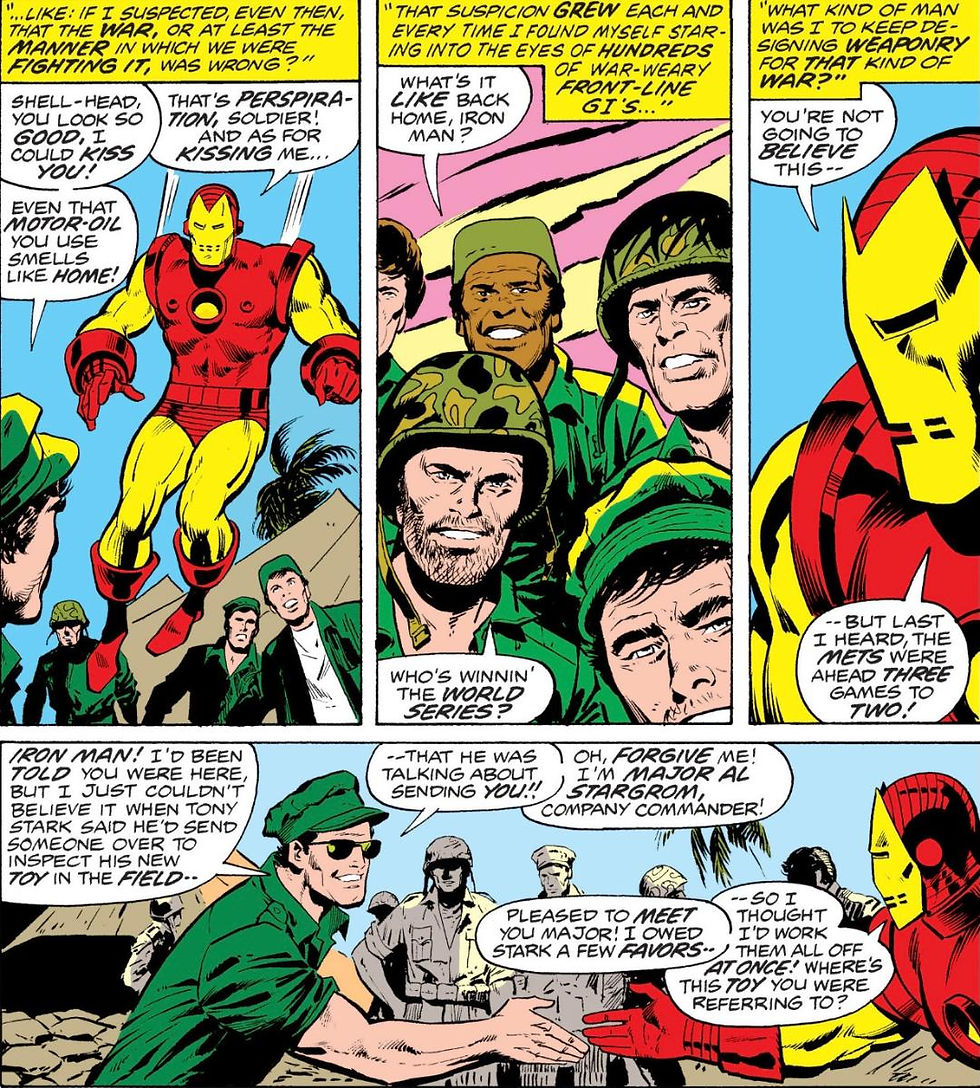
This flashback opens with our hero greeting the troops as he’s there to test a laser guided weapon that promises to fire fifty-pound shells over a distance of at least twenty miles. It’s also learned that this troop is there “unofficially” - meaning that if everything goes south, then the brass can deny any responsibility.
Sure enough, once those words are uttered, the friendly squad leader is killed by a sniper, launching a brutal attack from the Viet Cong. Iron Man jumps into action when enemy jets appear. Unfortunately, he’s caught between the explosion of a nearby missile and his new weapon and knocked unconscious, falling to the ground.

We’ve no idea how long Iron Man is out or why no one seemed to notice a guy in a bright red and gold suit. But when he awakens, our hero learns that none of the American soldiers survived the battle. Unfortunately, he doesn’t have much time to dwell on it as his chest plate is nearly out of power. This requires him to use the battery of a nearby vehicle for a recharge. This is yet another action that knocks him for a loop and back to being unconscious.
It needs to be noted this is an earlier generation of his armor and a timeline much closer to the accident that put the shrapnel near his heart.
Once Iron Man reawakens, he’s almost immediately fired upon from an unknown assailant. Furious, our hero starts to lash out until he sees that it’s only a young boy firing at him. A longer look reveals that this child is also blind.
With the guilt over this child as well as the troops, Iron Man carries him to his village. (Not sure why he doesn’t fly.) Unfortunately, upon arriving there, Tony Stark discovers that his new weapon proved extremely effective. There are no survivors in the village either.

Erupting with rage and frustration, Iron Man uses his repulsors to essentially bury the entire village under a huge mound of earth, finally burning the word “Why?” into it. From there, he picks up the blind child again, crying as he returns to what I assume is the American base.
From that somber moment, we return to the present with Tony Stark vowing to avenge the lives of those lost to the ignorance of people like himself.
Story
As far as the actual writing goes, word for word, Bill Mantlo’s provided the best written Iron Man story since I started these reviews with #30. The caption about “the metal man crying” has remained with me all these decades.

At the same time, as powerful as the story is, it’s also sadly out of place. The timing of this flashback left much to be desired. As I’d indicated before, it’s the second delay in continuity in three issues. “Long Time Gone” would have fit much better following the Black Lama conclusion or the conclusion of some other story. Or perhaps as an annual.
Another question I have about stories of this nature is where they fit into the actual continuity. Sure, we can call this an “untold tale.” But given the gravity of this story and the impact it had on Tony Stark, I also have to wonder how he could continue to manufacture munitions following what he experienced in this story. I’ve also always told myself that this poor blind child has received assistance of some form from Tony Stark since the end of this story.
Lastly, it struck me that Bill Mantlo seemed to be auditioning for the writer’s seat on this series. If so, I’m thinking of George Steinbrenner on Seinfeld back in the 90’s when he says in reference to George Costanza, “Hire this man!” 7/10

Art
If I’m being completely honest, George Tuska and Vince Coletta are probably not the best artists for a story of this nature. That said, both succeed in delivering a good portion of the emotional depth required. Which is challenging when the lead character wears a suit of armor over his face. Both wisely use both body language from our hero and others in the story to illustrate the pain building in Tony Stark. Kudos as well for their depiction of the blind young boy. Once again, Coletta’s smoothing over rough areas provides a much more appealing depiction of Viet Nam that ten issues earlier with Mike Esposito on Tuska.
Bottom line - their work is better than expected. 5/10
Wimp Factor
Considering that all the action takes place during a time when Tony Stark had a weaker suit and the old chest plate protecting his heart from the shrapnel, I’ve no issues with him running out of power and the other limitations. 3/10
Villain Rating
“Long Time Gone” doesn’t really offer any villains unless we consider the Vietnam War as the true adversary. Or perhaps Iron Man himself for the role his short-sightedness plays in the deaths of those villagers. No Rating
Overall Rating
Thumbs up to an earnest effort on Bill Mantlo’s part with art that also at least makes a valiant effort. This will be much better than most fill-in’s that we’ll see in the coming years. 6/10
Additional Nuts & Bolts:
Writer Bill Mantlo had started out as a colorist, but at that time began to quickly establish a name for himself by taking on what appeared any assignment requested of him. He would return this this book for another fill-in with issues #86-87 before returning in #95 with what would be a respected couple of years on Iron Man.

With this issue’s focus on Viet Nam, I’m reminded that this is a time when Marvel didn’t worry about directing tying their characters into specific historical events. Needless to say, it wasn’t too many years later than stories of this nature quietly went the way of the dodo.
If you are unaware of Bill Mantlo’s story, I am sorry to be the one to share it. Mantlo wrote for Marvel into the late 80’s as he was also in law school. Tragically, he was the victim of a hit and run driver, leaving him severely injured physically and mentally. He has been in assisted living since that time.


Comments